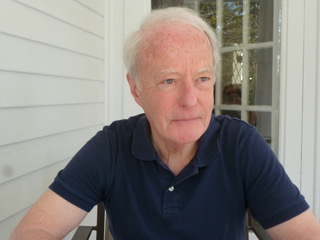
Years ago when I was twenty-seven years-old and my father fifty-eight, we wandered around an off-beat section of a small New England town. There was a section where old wooden structures had been abandoned years before and lay forlorn. But they drew us to them. Old names on walls, here and there a small plaque telling a little history of places and people long vanished, never to return, for the rest of this town had been modernized and gentrified, as was exemplified by the expensive shops and cars that lined its streets.
It seemed as if my father and I were moving very slowly, as if in a dream, along the back streets, dawdling, as Mark Twain wrote somewhere about smoking a cigar down by the riverside of the Mississippi, watching the river flow by. Lazy, slow, wondering and wandering, we read the faded names of an old tavern named Harry’s, a bakery, a tiny cobbler’s storefront, and a shed-like structure where the proprietor seemed to have sold or made or treated canes or cares – the third letter of the fading sign was missing – and where the wall had half fallen.
Of Harry’s absent tavern, my father said, “I wonder if it was a place where they drank beers and tears and laughed until they were intoxicated with happy grief. Your mother’s uncle Neil had a popular tavern on West 52nd St. in Manhattan. One day he was walking up stairs to an apartment and dropped dead of a heart attack. His widow had to sell the tavern. She bought a candy store on the next corner instead, and family legend has it that school kids robbed her blind and she had to sell the place. Do you know the poem, ‘Candy is dandy but liquor is quicker’?”
I did know the poem, but at the time I wasn’t sure what the connections were, for I had not yet fully grasped my father’s philosophic erudition and wit, or the repercussions of that day. I remembered it a few minutes ago as I was looking up at a hole high in a massive oak tree in the yard. Peering out was a small racoon, her masked countenance looking lost and inconsolable. For a neighbor, thinking he was ridding the neighborhood of pests and making everyone feel safe, had recently set many traps and boasted that he caught seven racoons and drove them into exile miles away where he released them. Where once the mother would look out that hole with three or four little ones on her back or watch them testing themselves on the branches, now the little face stares into the crepuscular light, wondering where her mother and siblings have gone. She only knows they have vanished. As Virgil put it long ago: “Three times I tried to embrace her and to hold her; / Three times the image, clasped in vain, escaped / As if it were a breeze or on the wings / Of a vanishing dream.”
The neighbor said he had bought the latest type of traps and they worked wonderfully, even going so far as to send a beep to his cell phone when he had caged an animal. Progress is our most important product, he said without saying it, echoing Ronald Reagan and that great weapons manufacturer General Electric.
I think of Ovid’s poem “Beach Body,” the desperate feel of recognition for a woman on the shore as the truth comes washing in with the waves, the grief of loss, the shock the wife feels as her former life vanishes and her husband’s body gradually becomes recognizable as it comes to her on his watery grave. Now shipwrecked, abandoned, the bewildered racoon child, like the wife, wishes to leap down, an “amazing thing: she flew, struck light air, bore wings compressed and turned, a desolate bird wave-bound.”
We are all now living in the world of the shipwrecked, the abandoned, the trapped, the vanishing. It’s still the old world yet it’s not. Last night I walked out and saw Venus and Jupiter shining steadily in the western sky, and the firmament sparkled with stars and a full moon. That view is very old and always new. People are still knocking golf balls into holes in the ground, redecorating kitchens, and scanning screens to check the weather for a week from next Wednesday. A rocket just blew up on its launch pad in Florida, but they will build another to get us all to Mars. Be reassured.
We have been poisoned with the words of liars, telling us all is well, the foundations are solid, and the walls will withstand the storm.
Ask the children of Gaza, if you can bear to hear their dead voices level with you.
Ask the shades of the victims of our bombs everywhere. They know.
Walls? Ask the Trojans. We have been slipped a poisoned gift.
My father’s words come back to me: ““I wonder if it was a place where they drank beers and tears and laughed until they were intoxicated with happy grief.”
Quién sabe? (Who knows?) – as he would often say. For they have vanished.
Edward Curtin: Sociologist, researcher, poet, essayist, journalist, novelist….writer – beyond a cage of categories. His latest book is AT THE LOST AND FOUND: Personal & Political Dispatches of Resistance and Hope (Clarity Press)
Dear professor Edward Curtin and friends. By the way, I was born on May 31st, 1988, in this capitalist world. I shared my thoughts with some people involved in the search for Nancy Guthrie, an 84-year-old woman who I believe was kidnapped by dark forces linked to the Epstein Crime Cartel.
Hey friends, check out the book by my revolutionary teacher Edward Curtin: “Seeking Truth in a Country of Lies.” It’s an inspiring and liberating read that can free people from mental slavery and the influence of mainstream media mind control.
Welcome back Knoxville Christian-Anarchist….I was born in 1947….so what ! My readings on the internet these days are about 3 year old children being used for target practice. Elderly people being sodomized for entertainment. People wearing neckties and ugly suits and for what reason! Corrupt teachers unions…!
For a break from the horrors everywhere, including the town near where I live…I simply cry and take naps with my cat Darcy.
I’m always curious, that’s why !
Thanks Ed.
Different critters here in aUStralia, same feelings.
Still wondering why wombats have square scats.
A beautiful piece Ed. That poor baby raccoon story touched my heart. Having spent the last month camping in Utah and Idaho backcountry I’ve been lucky enough to have taken in the sights of many fellow “creatures” and of “spring” in different locations and elevations. The many Killdeer mother’s walking about, who upon noticing me are keen to lead me in some other direction from the one I was on, suspicious that I might harbor ill intent toward her eggs. The prehistoric croaking of the sandhill cranes each morning. The bright luminous “new green” buds and shoots along the river banks that almost have an internal glow in spring sunshine. This natural world that surrounds me stands in opposition to “the words of liars” and nourishes me with simple potions of beauty and the sense that I am part of some bigger mystery. When I’m back in California I feel like that lonely little baby raccoon looking out and wondering – where the “real world” and my kin have gone. Thanks Ed.