“In the mountains of truth, you never climb in vain.”
― Friedrich Nietzsche
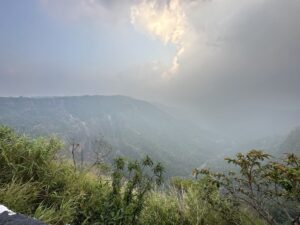
Early June. Dawn brings mist covered mountains and an empty road. The car’s capsule draws us together. I am taking my adult son to a trail that begins at the bottom of a ski slope where he will start a twenty-one mile run up and over a series of mountain peaks and through dense forests.
It is Sunday morning and soon many will awake and go into buildings to pray. Emerson and Thoreau suggested otherwise, and my son hears the same call. “Rise free from care before the dawn, and seek adventures,” said Thoreau. God is not caged in a building where preachers prattle about commonplaces meant to soothe bad consciences.
As he adjusts his running vest with its bottles of water, he walks toward the ascending path. From the rear, his curly hair and neck remind me of the little boy who loved nature so that he uncannily knew the names of every country and all their animals, as he now knows every bird and all their calls in an instant.
My heart opens like a flower as I watch him go.
Highly accomplished professionally and athletically, I think he runs to find the rhythm of life’s essence and the peace that passes all understanding. And to overcome himself. Always self-overcoming! I recall when I was his age how, when I went on much, much shorter and easier runs in natural surroundings, I would sometimes think of Leo Tolstoy or his character Andrei in War and Peace or Levin mowing with a scythe in Anna Karenina, finding the peace of the uncaged God in nature’s beauty and rhythmic movement. Now when I walk it is no different. And I too prefer to go alone.
I agree with Nietzsche, who wrote on scraps of paper while walking in the mountains: “Sitting still is the real sin against the Holy Ghost.”
I think of my father, with whom I talk regularly, who died thirty-two years ago and who walked city streets to different beats. He was conventional in certain ways, but from the stories I’ve heard about him when he was an age similar to my son’s, he did things that I would have warned against, but that I have come to realize are useless suggestions against God’s seal on one’s soul. Quien sabe? (who knows?) was his favorite phrase. I don’t. Advice can be crippling. I am a recovering crippler out of love, but a love filled with fear for the safety of those I love, although I too was like my father and son, and many would say I still am, in a different way. Love is strange. So is daring.
When my father was in his twenties, he was in a bar with his brother (both became lawyers). An off-duty cop was drunk and looking for a fight. He was brandishing his gun. My father pinned his arm to the bar, grabbed the gun, ran outside, and threw the gun down a sewer. Risky business.
When in his late fifties, he was riding a subway with one other rider, an old lady. He was dressed in a bulky overcoat and a fedora, looking like a NYC cop of that era. Four young punks entered and demanded his wallet. One said to him, “Are you a cop?” He replied, “Why don’t you find out?” And he put his hands in his pockets. The train stopped at the next station and the four jumped out.
Fathers and sons. The links are mysterious but true, and very strong. My father, the only grandfather my son ever met, was a beautiful caring soul, a conventional Catholic and politically mainstream with a highly sophisticated mind. I became a theologian in my early years but a dissident Catholic and a political radical who was fired from teaching positions for “heresy.” My father disagreed with many of my positions but fully supported me in every way. My son, like many of his generation, took a step further away from religion. He disregards it, but he is such a deep thinker that he travels circuitous paths to the contemplation of the mysterious, to marvel at miraculous nature, what is clearly spiritual, however you want to define that word. What C.S. Lewis in The Abolition of Man sums up as the Tao, that Chinese term whose reality is beyond all predicates. “It is Nature, it is the Way, the Road.” One enters the Tao following one’s chest (the seat of magnanimity, sentiment) – full physically – sensing, however dimly, that one’s feet will lead one into a reality beyond words where “the head rules the belly through the chest,” the middle element of feeling that leads the soul on through trained habit.
In a world becoming more disincarnate and mechanical, what could be more important.
When my father read the English writer Edmund Gosse’s classic account of his Victorian childhood and his conflicted religious relationship with his father in Father and Son – subtitled “a study of two temperaments” – he wrote to me to say it sounded like us. There was a sadness in his words tinged with a wise understanding that this was inevitable, for separate generations are affected differently by changes in society, and yet and yet, the fundamental things abide. Our deep love, most fundamentally.
My son and I have been affected by similar societal changes that have diffused the religious impulse into more diverse paths. Younger spirits don’t want to run on worn old soles. My son runs further and higher than I ever could. I thought I went deeper than my father. But the winding roads the three of us travel always intersect in ways our unknowing minds never know but our chests feel. These are the ties that bind us.
Wordsworth, in Ode: Intimations of Immortality from Recollections of Early Childhood tells us how they are rooted in childhood:
High instincts before which our mortal Nature
Did tremble like a guilty thing surprised:
But for those first affections,
Those shadowy recollections,
Which, be they what they may,
Are yet the fountain-light of all our day,
Are yet a master-light of all our seeing;
Uphold us, cherish, and have power to make
Our noisy years seem moments in the being
Of the eternal Silence: truths that wake,
To perish never;
Which neither listlessness, nor mad endeavour,
Nor Man nor Boy, for beauty
Nor all that is at enmity with joy,
Can utterly abolish or destroy!
High on the mountain ridge two huge rattlesnakes eye my son the eagle as he passes a few feet from them. He thanks them for awakening him on his long journey and photographs them as he dances past their coiled bodies where a sublime vibrating landscape greets him. Beasts lead the way to beauty if you’re brave. “And he who is not a bird should not build his nest over abysses. . . . You stand there honorable and stiff and with straight backs, you famous wise men: no strong will and wind drives you. . . . Thus spoke Zarathustra.”
In his essay, “Create Dangerously,” Albert Camus tells us that beauty never enslaved anyone, just the opposite. Without beauty, we would perish. And in the Duino Elegies, Rilke tells us that “every angel is terrifying.” What is an angel but an image of beauty, and before transcendent beauty we can only bow down in reverence. Art takes a multiplicity of forms: words, paint, music, etc., but it is always incarnated expression to be true to human experience. Like mountain running.
Camus:
After all, perhaps the greatness of art lies in the perpetual tension between beauty and pain, the love of men and the madness of creation, unbearable solitude and the exhausting crowd, rejection and consent. Art advances between two chasms, which are frivolity and propaganda. On the ridge where the great artist moves forward, every step is an adventure, an extreme risk. In that risk, however, and only there, lies the freedom of art. . . . the free artist is no more a man of comfort than is the free man. . . . Danger makes men classical, and all greatness, after all, is rooted in risk.
Create dangerously, as he said.
Four hours later, I drive twenty-five miles to the southwest to meet my son. I wait in a little dirt parking lot where the seven mile trail down from the last mountain peak is so narrow that one can barely get through it. I push through and look up in fear and awe. The path cascades down over rocks and heavy brush. No one is in sight. Then, further up, I glimpse movement around a bend and down comes my son flying like a wild bird with feet – grinning.
“How was it?,” I ask him.
“Fine,” he says, in his laconic style.
When we get in the car to drive home and he is gulping the bottles of water that I have brought for him, his grandfather, my father, startles us from the back seat. He says, “Have you guys ever heard this poem?” And he begins to recite it in his mellifluous voice as we roll along.
Sometimes A Man Stands Up During Supper
By Rainer Maria Rilke
Sometimes a man stands up during supper
and walks outdoors, and keeps on walking,
because of a church that stands somewhere in the East.And his children say blessings on him as if he were dead.
And another man, who remains inside his own house,
dies there, inside the dishes and in the glasses,
so that his children have to go far out into the world
toward that same church, which he forgot.
Edward Curtin: Sociologist, researcher, poet, essayist, journalist, novelist….writer – beyond a cage of categories. His new book is AT THE LOST AND FOUND: Personal & Political Dispatches of Resistance and Hope (Clarity Press) edwarcurtin.com
I was going to post this comment on the previous article about desolation, because that’s how I feel living in the USA, where it seems only about 10% to 20% of the population is aware and sharp, while the remaining 80% are misled and influenced by the mainstream media.
I’ve been an active member of several YouTube channels dedicated to investigating the case of NBC Democratic Party journalist Savannah Guthrie’s elderly mother, Nancy Guthrie, who was kidnapped and murdered. Many of these channels have a right-wing, Republican, bourgeois mainstream perspective, and I’ve often said that when crimes like kidnapping, murder, or robbery occur, we should be open to multiple theories about what might have happened. I’ve suggested that this case could be connected to the Epstein scandal, and that Nancy Guthrie may have been the victim of a state crime carried out by political and ruling class figures tied to the Epstein mafia network. This belief stems in part from Savannah Guthrie’s 2019 NBC interview with Virginia Giuffre, who I believe was killed by dark forces associated with the Epstein mafia sector.
I told people to watch the video “The Gangster Nature of the State” by Michael Parenti and to pick up 5 powerful books to help break free from the illusion that the USA was founded as a paradise, is a force for good, and is governed by a Christian moralist elite. These five books are filled with hard truths, because reality can be ugly and painful.
1- “A True History of the United States” by Daniel Sjursen
2- “Seeking Truth in a country of lies” by Edward Curtin
3- “Empire of Lies” by Paul Craig Roberts
4= “Endless Holocausts- Mass Death in the History of the United States” by David Michael Smith, David Michael Smith (Professor)
5- “We the elites – why the US Constitution serves the few” Robert Ovetz (Talks about all the bullshit of the USA Constitution and US Founders
You know what happened? Most YouTube channel owners deleted my comments and banned me because people seem to hate liberty and wealth, and instead embrace poverty and pain. That’s the truth. Most people aren’t like Edward Curtin, me, Tucker Carlson, Alex Jones, or Chris Hedges—they don’t care about better living standards or a great life without crime and corruption. That’s why Foucault said that in Nazi Germany, most Germans actually loved Hitler, voted him into power, and supported him. And in Israel, according to anti-Israel journalist Aaron Matte, most Israelis support Zionism, the genocide of Palestinians, and Netanyahu.
The majority of people are like that—decadent and inferior. That’s why Nietzsche said everything good belongs to the minority. The intellectual and moral aristocratic elite of every nation is a small group, while the majority—the rabble, the decadent, the complacent—support the status quo of the world.
It’s often impossible to convince people of any ideology that represents a force for good. This is why even evangelical progressive Christians struggle to persuade others to embrace the philosophy of life taught by Jesus Christ. People seem to resist anything that is truly good.
The same goes for Marxists and communists—it’s hard to persuade poor Americans that under socialism they could enjoy higher living standards, free healthcare, free college, and other benefits that might spare them from the difficult life they’re forced to endure in the challenging environment of the USA.
PS: I just found out that Publix Supermarkets have socialist traits. They’re owned by their workers, which is one of the core ideas of socialism—“workers’ control of the means of production.” No wonder shopping at Publix is such a pleasure.
You have written so many in-depth, revelatory & profound articles Edward, but on this day particularly, it is hard to imagine anything surpassing this. I certainly feel lifted up. Way up inside. & Thank you.
Who walked great distances consistently and who is not in our awareness, in our text books and libraries? There is one decent aspect of the internet, one can quickly discover other cultures, their art, music and dance. their ’thinkers’ How far many people have walked everyday. (It is sad that the internet has become a shopping…, a cesspool for the most part.) I don’t walk 10 miles every day of the week. I simply march in place in quick sand ! I don’t dance or sing or play a musical instrument!
A beautiful piece Ed – thank you.
What a great story, I wish you were my uncle. What a great story about your son and your thoughts on churches. You’re absolutely right, and even Nietzsche agreed that true Christianity is grounded in altruistic, socialistic, and cooperative behavior toward others. It’s really a philosophy of life that doesn’t rely on the symbolic rituals promoted by organized religion, like kneeling to pray or baptism.
According to Tolstoy, real Christianity is anarchist by nature, opposing many things that most traditional modern Christians support. It is anti-state, anti-border, anti-wealth, anti-nationalism, anti-consumerism, and anti-materialism. That’s why I believe many members of Christian churches in America treat them more like social clubs or hobbies rather than truly practicing an authentic Christian philosophy of life.
In fact there is even an essay that claims that only communists will go to heaven:
Here is the link of that article https://zizekstudies.org/index.php/IJZS/article/view/1011
By the way, speaking of walking, I read that Nietzsche, like Thoreau, Kant, and many other great thinkers, was an avid walker. I think Hemingway and Ralph Waldo Emerson also loved walking. Apparently, when Nietzsche was in Turin, he would walk for an hour in the morning and three hours in the afternoon. I can’t help but wonder if he ever felt too tired from it.